
Hiroshima and Beyond
The Hiroshima Maidens and Operation Alert

Some time ago I shared Leivick’s article about the Castle Bravo nuclear test and mentioned that that wasn’t his only engagement with the new, atomic era. Today I’m going to return to the topic and look at a few of the other pieces I mentioned, as well as a newer find.
In 1955, 25 Japanese women who had been disfigured in the bombing of Hiroshima — the ‘Hiroshima Maidens’ — arrived in New York to begin treatment at Mount Sinai Hospital. The legacy of this event is a hotly debated one and was so even at the time. And Leivick’s response in Tsukunft to the visit and treatment is certainly very indicative of American (and male, I might add) attitudes about these women.
A stylistic thing that surfaces often in his prose works are these short, more poetry-like lines. When I translate for myself, I try to keep them as I find it so characteristic of his writing (and admittedly grumble if I’m forced to make it less ‘choppy.’)
The Hiroshima Maidens
The atomic bomb twisted and warped their limbs.
The atomic bomb burned and pitted their faces.
They were young, almost still children when the bomb fell on their home town of Hiroshima.
They were within the walls of their school when the fire, or the smoke, or devil knows what, reached them, melting and crippling.
Yes, they were young, they were almost still children, when the radiation, or the flash, or devil knows what, made them into monsters — and then young men didn’t want to befriend them, spend time with them, not to speak of falling in love with them.
And they have lost every hope of marriage, of having husbands and children and being equal to others.
The Hiroshima Maidens will be sung about, together with their hiding places, where they conceal their faces to this day.
Particularly, particularly — their faces.
The Hiroshima Maidens will be sung of later by poets.
But they, the Hiroshima Maidens, will be more tragic than all the songs sung about them.
***
I saw some of them in photographs in the newspapers here.
Cameras captured them when they came to New York by airplane.
I saw how they held their hands over their faces in order to hide them, to conceal them from the eye of the camera.
The Jewish hospital in New York, Mount Sinai, brought them from Hiroshima to heal them of their injuries and disabilities.
A blessing on Mount Sinai Hospital.
But the hospital wasn’t able to bring all the Hiroshima Maidens affected by the bomb here, only a portion of them.
Nevertheless — a blessing on the hospital.
Because were an atomic bomb to make ruin of the whole world, to crumble it, reduce it to dust — well, so what?
If people wish to destroy their own world — let them!
But if the limbs and faces of maidens are deformed and young men don’t wish to befriend them because of this, and don’t wish to marry them because of this — and the maidens must, because of this, forever remain isolated and ashamed, and must forever, if an eye falls upon them, hide their faces with their hands — this is a greater misfortune than the destruction of the world.
Yes, a greater misfortune, lords and masters of the world.
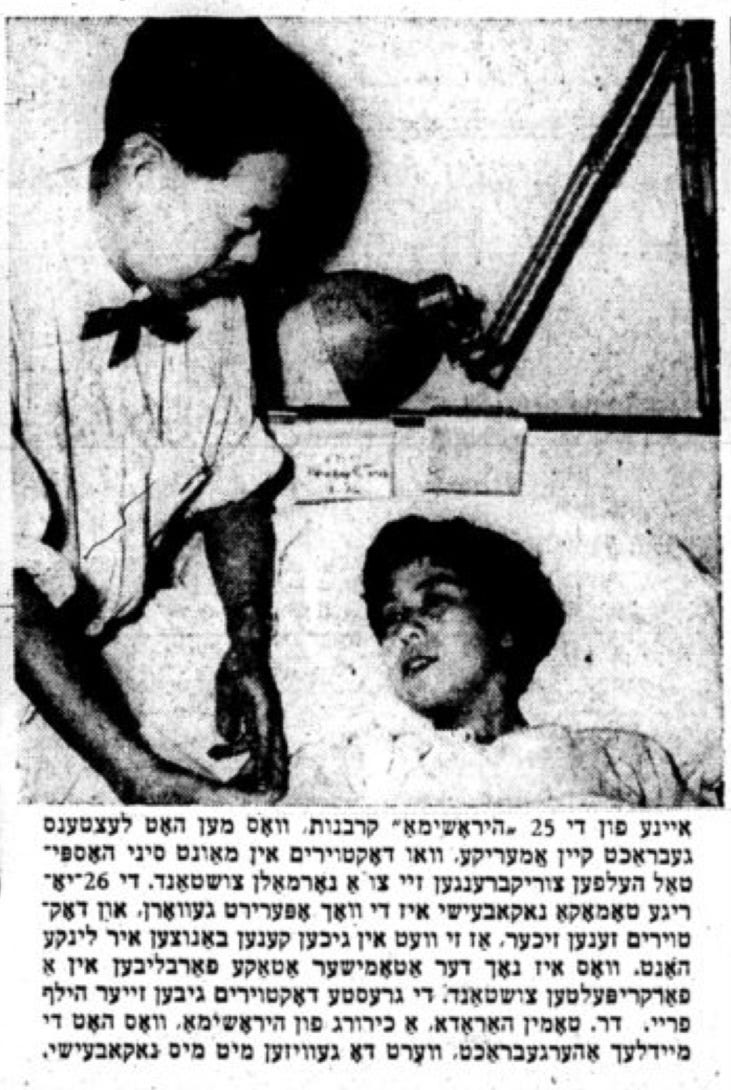
Tomoko Nakabayashi, Hiroshima survivor, in Der Tog
Leivick later goes on to record his own experiences with the ‘Operation Alert’ drills that took place to gauge New York’s reaction to a new kind of bomb — the H-bomb.1
When the Sirens Wail
The press has announced that on such and such a day, in the morning, there will be an atomic bomb alert, which will also be a hydrogen bomb alert. It will be, it seems, a rehearsal — an announcement that the terrible bomb is on its way, a warning and an examination of how the population of New York and dozens of other cities in the country will conduct themselves; how the inhabitants will descend into prepared cellars, bunkers, shelters, etcetera; how activity will immediately stop across all of New York, and how the designated supervisors will see to it that the sheltering of the population should proceed in the best order.
It isn’t the first time a resident of New York has experienced an alarm test like this. But this time I, as one of these residents of New York, took it more seriously than before; I was filled with a particular fear, a particular anticipation. Why? — Perhaps because the current test is connected with the alarm about the hydrogen bomb, the explosive force of which is inconceivable: One such bomb is enough to make a ruin of all of New York and wipe all of us out in the blink of an eye!
I was, as in previous cases, aware that it was only a test, a rehearsal, and this rehearsal would only last ten, fifteen minutes. Nevertheless, I was filled with anxiety. The night before the designated test-morning, I couldn’t sleep. I lay there and thought: What would it be like if, before the morning came with the rehearsal and the imagined arrival of the enemy’s attacking bombs, the attacker indeed truly appeared now, in the middle of the night, and dropped a hydrogen bomb or two on New York?…
I lay there and said to myself: I have to wake my wife and we must immediately, this very instant, start running. Where? To the basement of our six story apartment building. Of course! There! Into the cellar! Because where else should we run?
But I immediately said back to myself: What will the cellar help us? Even if I don’t call it a cellar, but a ‘shelter’ — what sort of hiding place could it be for us? What sort of protection could it give us against a hydrogen bomb?
It’s good it was only a night-time imagining, a wild thought. I didn’t wake up my wife. I lay there until light; I breathed easier when day rose in its full illumination and certainty, in all of its great New York noise, animation and zeal.
The morning entered the eleventh hour. And suddenly — alarm! Sirens wailed, warning, moaning, cutting into one another. The sirens announced that the ersatz-attack neared. Be prepared, New York! Get ready, millions of New Yorkers! Stop all your movements! Save yourselves! Run to the shelters!
Now I must certainly take my wife and go into the cellar. But just then, a voice carries over me still more: Where will you run?
The voice transforms into a voice of mockery, ridicule: Foolishness! Senselessness! You’ll run to cellar, just to certainly be buried beneath a mountain of rubble from your home and beneath the rubble of all of New York. What, then, should I do? I ask, It’s an alarm, after all. It’s an announcement of the possibility of danger! What, then, should I do? Should I perhaps not run into the basement, but start to run to the very outskirts of New York? Should I perhaps flee New York entirely?
You can’t run anywhere! Warns the mocking voice, the streets must be emptied…the streets are already empty. Go to the window and look.
I go to the window. I look out into the street. Still. Not a soul in the street. Not a rumble of motor.
Where there is a vehicle — it stands as if frozen. The sirens wailed out their warning and — they fell silent. They waited.
I stand by the window and I see the whole joke at my own expense and — I suddenly feel a despairing calmness. I say to myself: That’s right, that’s right — don’t go into the cellar. It’s useless. The senselessness of mankind has brought atomic destruction upon mankind itself. Mankind itself has sought out the annihilator and unleashed it over its own head. Mankind itself has revealed it.
Instead of revealing it for the good, for redemption, to be of use — it has revealed it for misfortune, for annihilation, for total death. A weapon, with which one explosion, wipes out an entire island, reduced it to dust and drowns it in the depths of the ocean — what idiocy it is for the creators of this weapon to play at a children’s game of alarms, of sirens, of hiding-places and shelters — if a hydrogen bomb is dropped on a New York, or on a Moscow, or on a London — what a joke to think you could save yourself by hiding under a bed!
I stand be the window and am no longer afraid. An inertia fills me. The inertia of a hopeless serenity.
The senselessness of the rulers of the world, of the paranoid powerful, has obtained full atomic power over me, the helpless, the unprotected — over me and over all the millions and millions of helpless and unprotected of the entire world. They can, at any moment, kill me, reduce me to dust. In killing me, they must also kill themselves, atomise themselves over all the empty spaces of the world. They don’t come to their senses, though. They hold total destruction ready over the peoples and countries of the world, total death. They shower hideous fear down on my head; but of this fear, there becomes a stoney calm in me. The day is bright. The sky is clear. A cloud or not — it doesn’t make a difference. The day isn’t guilty of anything, the sun isn’t guilty of anything.
With bright radiance, the eye of God looks down — and God’s eye certainly isn’t guilty of anything. No, I won’t run to the shelter on a day when a mad mortal wants to blow his own world, the whole globe, apart. I won’t run and hide in a filthy cellar!…
I stand by the window. I look out into the dead street. And I think about what this street will look like on the day a human being gone mad, a degenerate ruler, someone greedy for power, blows up the Earth.
The wailing of the sirens rises again — they announce the ersatz attack is over, the test. If you can say such a thing, successfully…But I almost don’t hear the sirens. They don’t cheer me. They tell me nothing. They warned of nothing and they saved nothing.
H. Leivick, Tog, 26 June, 1954
Leivick provides us with a post-mortem on the alert — no glibness intended — and something extra, which I will share next week!
I must note that this piece is particularly evocative for me, because my shul had a sign in the stairwell that led down to the basement rooms, where the children’s services met, there was a yellow and black sign that announced the shul basement’s status as a fallout shelter. It frightened me so badly that in twenty-odd years, I only went down those stairs once.