
Darwin
Extending our stay in Denver

I don’t have too much explaining to do about this one, other than the fact I’ve always liked it.
Lider fun Gan Eyden (1937), as I’ve said, is a book very close to my heart and the first Yiddish book I read cover to cover. One of my first ‘projects’ was annoying my Facebook friends with one poem after another as I worked my way through it during our Covid lockdown.1
And one of my favourite — almost funny, if you can believe it — poems is ‘Darwin.’ I sympathise very much with the feeling of anywhere but here, anyone but me.
Darwin

I read Darwin— the book of our origin,
And all around and over me the scent of carbolic,
Thermometers, milk and poison-iodine —
So much stillness gathers for once.

No more details are necessary, no more features,
You need no amazement, nor any fear;
Now I walk away from myself,
And will walk even further away.

Good Grandfather Darwin has brought me
Gifts — wonders — in a full sack;
The day sets, the evening comes, the night—
And now my ancestor strokes my cheek with his paws.

Such dear claws of yours, Father,
Such a curly, fiery-red pelt;
Oh, take me in your strong arms,
And bring me home to your den, to your door.

Oh, ancestor of mine, Orangutang.
I have wandered in a strange place,
Now from my heart there comes
Such a wailing-yearning for my jungle-land.

The distant, sweet, childhood days—
Father would dance around on large feet,
And swing on tall trees by his tail,
And, for our sake, heap up a pile of nuts.

For us— the small apes. And I —
I was the oldest ape — the firstborn —
Used to perform tricks, leaping and climbing,
Plucking out handfuls of my hair.

I take a quick, unexpected leap,
An now I am with my father in the heights,
And I immediately swing, I sway,
And fall down on mother’s soft belly.

Mother’s soft belly— How warmly sweet,
As you but touch it — in a fluid motion,
Mother, out of love, gives me an actual bite,
And clasps me deeper, deeper to her breast.

I gaze at her and all becomes quiet, still,
Her eyes dance, trained on her son.
I carry a joy that I alone feel —
My little brothers don’t know it yet.

Thanks to you, good Darwin, for this greeting
For my origin beneath palm-tree,
Thank you for the bananas and the coconuts—
The dearest gifts from my jungle-home.

You know the way from the jungle-home to this place —
You look upon me with wonder in your gaze;
Do you perhaps know also, Oh, dear, good sir,
The way that leads back to the jungle?

I don’t want to be where I am — I don’t like it;
And that which I am today — is strange to me;
Where is the limit to walking with light tread,
And wearing a bloody shirt on a white body?

Oh, come with your hairy paw-hands,
Oh, Father, with your mighty jungle-stride,
And take me away from this world of stair and wall —
I want to go back to being your son, Orangutang.
I said there’s not a whole deal of explanation necessary here and there really isn’t! I will direct you to a passage in Oyf Tsarisher Katorga where Leivick writes about his first readings of Darwin and his initial revulsion at the idea of evolution:
I sat on the tumba and watched as my neighbour scrubbed and washed with sweat pouring down his face. From the previous two weeks in quarantine, I’d already had a taste of this washing and scouring. I asked if I might help, but my neighbour said nobly: ‘Thank you. You may rest on your first day in the cell. You’ll scrub yet, comrade. Tomorrow will certainly be your turn.’
The whole time that I watched him, I saw a deep unease in his face. All the while, in the middle of his work, he would stop as though frozen for a moment, shudder with his whole body, and resume his work again. I wanted to ask, but stopped myself.
On his tumba, I saw, lay a book: ‘The Origin of Species’ by Darwin. I’d already read it a year previously. I flipped through the pages and was struck by the illustration of the orangutang. When I first saw and read it, I was filled with revulsion at the thought that I descended from an orangutang. I couldn’t believe the idea there was any kinship between myself and that ape. Now, at this moment, I almost found the image amusing.
It conjured a picture of a sunny tree with large branches, a breeze passing by me, and the warmth of a hairy, good-natured soul, who danced about free, free, free…no need to scour any copper pots.
———
My neighbour finished his work and sat down near me. In my eagerness to start a conversation with him, I said ‘Excuse me. I’ve taken your book —‘
‘Oh, it doesn’t matter. You can keep the book, comrade. I’ve already finished it.’
‘I’ve already read it too,’ I said, ‘but it doesn’t hurt to refresh the memory.’
Another moment joining the sanatorium experience, as explored here, and his prison experience is in the poem ‘Clink-Clank’ (as it’s been translated elsewhere) which relates a prisoner’s dancing with his chains on,2 pulling all the grey hairs from his head.
A year after Lider fun Gan Eyden, in 1938, Leivick would publish a prayer, in the voice of the biblical Cain, as part of his reflection on the still-rising tide of violence in Europe, in which Cain asks God not to refer to him as a gorilla, even though he’s just invented murder…
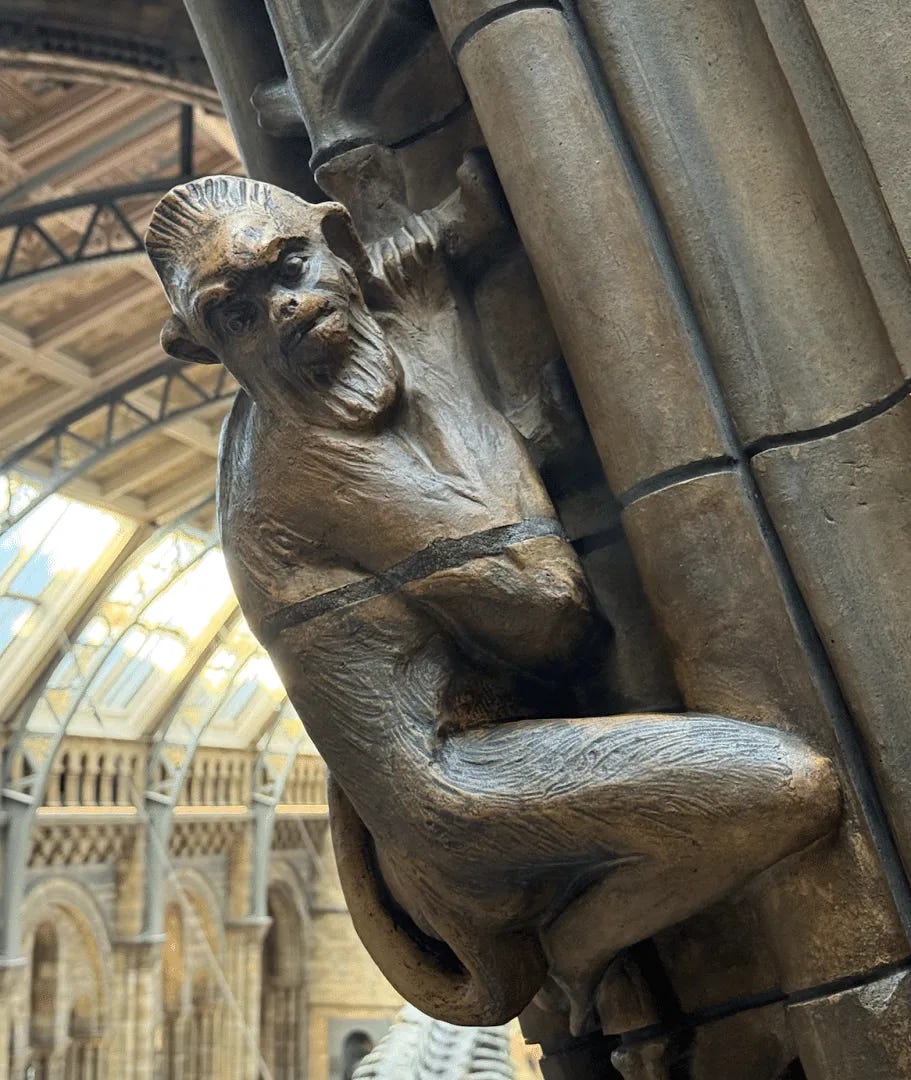
A monkey at the Natural History Museum in London that may or may not be modelled on Darwin. I recommend taking a good look at the outside of the building, too, if you’re in the neighbourhood (bring your opera glasses).
They also got daily updates on Oyf Tsarisher Katorga, too. My victims generally fall into two camps: those who obviously try to chew off a limb to escape and people that politely pretend to be interested and escape when I’m not looking,
This chain dance also appears in both Oyf Tsarisher Katorge and Chains.