
Digging
The Archaeologies of Messieurs Heaney and Halpern

In another life, before I was a terrible jargonist, I was doing a PhD in Irish literature — so you’ve very narrowly been spared the Diary of a Disgruntled (Defrocked?) Joycean and pictures of my four different copies of Ulysses.1
But I don’t consider the two great loves in my life to be in fundamental opposition to one another. They coexist very smoothly, one informing and helping the other along. One, in fact, sparking the other. The ‘Caoineadh Airt Uí Laoghaire’ (Lament for Art O’Leary)2 seemed to lead me naturally, organically into ‘Der Volf’ (The Wolf). Specifically through Doireanne Ní Ghríofa's Ghost in the Throat, about her translation of the poem. I don’t read Irish, and I didn’t read Yiddish at the time, so I had these two slightly-strange-to-me documents in translation in front of me at the same time. Both dealing with the idea of a grief so deep as to entirely alter a person’s being and physical form, pushing them to the extra-ordinary, the supernatural feats of strength, the spilling — and even drinking — of blood.
One thing that did become clear to me during my abortive academic career was the accessibility of poetry. And sometimes that of the poet. Should a poet and poetry be instantly accessible on some basic level? I think so. Understandable in all their mysteries? That’s a different question. Any poem forces you to sit down and learn the language of the poet; what they’re saying and how they’re saying it to you. Are they straightforward? Or are they playful or even malicious, full of tricks that don’t only rely on the word, the language, but on the form, on the rhyme, on the meter? Do they require a key beyond that of the poem itself?3
Heaney is the poet from my time in academia I think of as particularly accessible, both as national institution by the time I came around to study him, with plenty of resources and criticism to be had, and because of the fact that, in the course of my Masters, I wrote to him and he wrote back. And he was nice.4 I haven’t forgotten that generosity.
Heaney is also where I get my love for (or fixation on) looking at different versions of the same poem: a conference paper I gave about two decades ago on versions of one canto of ‘Station Island’ — in which Heaney meets Joyce, á la Virgil and Dante, in crisis of religious and artistic faith — is the springboard, in a sense, for things like my fascination with the two versions of H. Leivick’s ‘Bullfight’ and it’s sparring with religious, political and humanistic faith.
I also, I fear, read Leivick’s meeting with Spinoza at the sanatorium under the slightly woozy influence of Heaney’s meeting with Joyce. If an imagined Joyce gives Heaney artistic permission, what does the TB fever-dream of Spinoza give Leivick? I’m still not sure I know completely, though it’s maybe a bit less mysterious to me now, and other people have certainly written about it — though I don’t always agree with them.
But if we agreed about everything, what would there be to write about?
I’m going to go all the way back to Heaney’s first collection, Death of a Naturalist (1966), and that poem which has become so (in)famous: ‘Digging.’ Here, as we do with Leivick’s ‘Ergetz vayt,’ we make a concession that this is Heaney’s ‘first’ poem, that he sticks the landing on his first try.5 But it’s really only the first one that he was confident enough to call a beginning.
Both Leivick and Heaney are perhaps more exciting poets to me before they are ‘very important’ poets, before they hit the status of national treasure that confers the lifetime achievement awards and honorary doctorates. Not that they are lesser poets later by any stretch of the imagination — merely that their younger selves are a different sort of electrifying (to me, anyway) than their ‘poetic institution’ selves, when they have to try to live up to their own earlier example.
We have to imagine ‘Digging,’ as we do with ‘Ergetz vayt,’ as a new poem, the first time it was printed, the first time it was read aloud, announcing a new arrival, a new voice. Something that was breaking new, untouched ground, something going after those ‘riches kneaded into the earth’ (to approximate Leivick’s words).6
Digging

Between my finger and my thumb
The squat pen rests; snug as a gun.

Under my window, a clean rasping sound
When the spade sinks into gravelly ground:
My father, digging. I look down

Till his straining rump among the flowerbeds
Bends low, comes up twenty years away
Stooping in rhythm through potato drills
Where he was digging.

The coarse boot nestled on the lug, the shaft
Against the inside knee was levered firmly.
He rooted out tall tops, buried the bright edge deep
To scatter new potatoes that we picked,
Loving their cool hardness in our hands.

By God, the old man could handle a spade.
Just like his old man.

My grandfather cut more turf in a day
Than any other man on Toner’s bog.
Once I carried him milk in a bottle
Corked sloppily with paper. He straightened up
To drink it, then fell to right away
Nicking and slicing neatly, heaving sods
Over his shoulder, going down and down
For the good turf. Digging.

The cold smell of potato mould, the squelch and slap
Of soggy peat, the curt cuts of an edge
Through living roots awaken in my head.
But I’ve no spade to follow men like them.

Between my finger and my thumb
The squat pen rests.
I’ll dig with it.
We have all that stuff — stuff, as in material, physical matter — from which so much of Heaney’s best known poetry will come; all that easily-satirised squelching mud. If it weren’t so distinctive, you couldn’t parody it half as well.
It also prefigures all those bog body poems of his that hint at a violence buried in the past, steeped in the soil itself from time immemorial. One cut of a shovel into the peat and up it comes, fresh as the day it was buried. And they’ve got that whiff of sadism, too, participation in the form of a tacit agreement with the violence being done to the body. Or at least a slightly chilly observer’s eye as it all takes place: ‘the artful voyeur.’
It’s semi-fashionable at the moment to dump on Heaney, his popularity, and those too-imitable sounds of his; the famous Seamus, as his close contemporary, the critic Seamus Deane, termed him. But if we’re honest, that’s what we like about him, too — the appearance of simplicity.
We also have those great jabs from Manger and others about Leivick as at least part cult of personality. But we also have him lauded for the clarity and simplicity of his writing. Leivick himself addressed complaints about his themes (see below) and his frequent, rather rigid rhyme (four line stanzas, abab) — but noted he found it freeing and inspiring rather than straightjacketing.7 And some of those ‘faults’ are exactly what I like so much about Leivick.
And on my part, I’ll counter this with a poem I’ve long found strikingly similar in spirit to ‘Digging,’ if not necessarily in form or language: Leivick’s ‘Lid veygn zikh’ (Song of Myself or Poem About Myself, but I prefer to lean into the seeming allusion) in 1937’s Lider fun Gan Eyden. Under this Whitman-esque title,8 we find another poet at work using his pen as digging implement.
There’s a slight difference, though, in that this poet had wielded the shovel and the pick himself — unlike those who came before him — digging at least one grave and breaking the ice on the river in Siberia. Also unlike Heaney — there can be no pretence of this being a ‘first’ poem. It comes a few books in, in the middle of a book.
Song of Myself


I saw whipped bodies
And the blood that ran from them;
Afterward, when I became a writer,
I wrote poems about the snow.

People loved those poems
Because they were white as snow,
But they often disgusted me,
Because I had covered the blood.

Years passed this way,
And it deeply troubled me.
I became a writer forever,
And the blood waited beneath the snow.

Once I took up the pen
And scraped away the layer of snow.
And all took fright,
As the earth spattered their faces with blood.

The blood was still warm,
As though only just shed;
It raised an angry din:
—Why does he torture us with blood?

Hard voices cursed
My songs, struck at their step,
My heart fell in two
At the battered feet of my songs.

People waved barbed switches
waving them back and forth,
Striking my poems’ bare bodies
With their hatred.

My poems — they wept,
As woe was already in their nature,
And remained lying on the earth,
But, finally, no longer covered by snow.

I have always been a writer —
My truth is still this:
In the blood of whipped bodies
Lies my whipped name.

My songs as well,
And so they should lie;
Perhaps I will cover them again,
When I have new snow.
I haven’t made this rhyme — it follows Leivick’s frequent, possibly most frequent, form of quatrains with rhyming alternate lines — but I think you can get the picture.
Here too the pick and the pen reveal human history, including a history of violence, instead of more mundane ‘riches.’ It isn’t mummified bodies that are uncovered, but the blood — still hot, only just iced-over. Digging down also reveals a personal history, as it does with Heaney, that Leivick was always a writer, and that this ’treasure,’ and this blood, waited for him to find it and himself.
Of course the blood, the wounded body it implies, is also a treasure. He’s putting his name and his words out there to be whipped. Perhaps all writers are, in that respect, slightly masochistic.
Will there ever be enough snow to cover all that blood again? It’s a slightly tricky issue. Snow does fall again in 1945’s I Was Not in Treblinka, in ‘My Longed-for Snow Has Come,’ covering what seems to be a child’s grave, marked only with a number. It’s not really the same, sanitising and obscuring snow — only one that lets you rest a moment before you realise exactly what the shape beneath it is.9 But we still find him longing for the snow that will cover it all in the sonnet ring that closes the book (again, a literal translation here):
How should I again bring the song of white snow?

And I must bring it, through life or through death —
And again cover the blood, the white and chain,
So that in purity there may tread

The feet of one who has heard my voice,
In whose heart, nursed on the pain of love,
Still trembles the dream of true poets.
There’s another major difference between the two poets. Heaney finds his own tool to metaphorically continue the work of his forebearers — or, as he says in his own speech about ‘Digging,’ the seemingly lighter tool to wield, while Leivick is at least half looking back at his grandfather’s refusal to ‘make an adze out of the Torah’ — to turn his learning into a tool, a financial means. And there’s something significant in Leivick’s own manual labour, at least in his earlier career, his taking up of those more traditional tools alongside his pen.10 I can’t read his pieces that mention things like running a sewing machine over your fingers without the visceral feeling that he’s either done that himself or been sitting next to someone who has. It might not have been working the fields, but it’s physical enough. And, of course, there is his actual ice-hacking and grave-digging in Siberia.
As for Heaney’s pen being ‘snug as a gun,’ with the insinuation of doing more violence as well as being the shove, that uncovers it — Leivick’s pen sometimes has the point of a spear, the blade of a knife or sword. I don’t know that we ever get the sense of Heaney’s pen really firing, even metaphorically, only its documentation (or his spectating) of violence, but Leivick’s pen certainly, he tells us, leaves broken and wounded lines in its wake almost as often as it strings words and letters like pearls.11
This isn’t the only poem by Leivick where you find traces of the people (if not always the bodies themselves, as in Heaney) that have passed through in the ice — you can go back to the beginning and find those Siberian poems with the remnants of people in the ice; bootlaces, book pages…but I’m interested in the digging and the self-revelation here, as well as the idea of Leivick’s ‘name.’ Both Leivick’s ’Song of Myself’ and Heaney’s ‘Digging’ are declaration of intent and ‘branding,’ so to speak, and a realisation — just look at that certainty building in Leivick: when I became a writer, I became a writer forever, I have always been a writer.
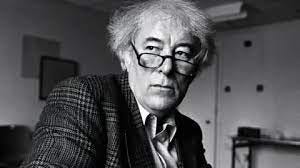
Am I a just a fan of a rather striking head of white hair? Could be.
These can still, I suppose, be provided upon request if you’re honestly curious. It’s not that exciting. I do have a nice hand-fan from Bloomsday at the Rosenbach Museum many years ago! I’ve done the stations of Ulysses around Dublin and have the T-shirts (and used to have the lemon soap) to prove it. Also, my name rather neatly inverts to ‘L. Bluma.’
Sometime I feel I go too far in disassembly of a poem and I’ve taken apart something quite alive and killed it for the sake of seeing how it works. And I almost always lose the rhymes, because I personally favour a fidelity to word and content over the meter and rhyme, though Leivick himself wouldn’t trade any aspect. Including the Yiddish.
No shade intended — the other authors I worked on and had the pleasure of meeting were also friendly enough. But my awe at receiving a kind, helpful reply from Heaney remains unchanged twenty years later. And it marks the last time I felt poetry the way I’ve felt it for the last six years.
The new collected volume remedies this, giving us some very early uncollected and occasionally pseudonymous work.
You could make a case that ‘Ergetz vayt‘ is the better comparison, especially given that we have Leivick breaking that poem down in some detail regarding its genesis and construction, and the breakthrough it’s selection by Liessin and appearance in Tsukunft was, or you could take both ‘Ergetz vayt’ and ‘Lid veygn zikh ’ in comparison to ‘Digging,’ but I’m specifically interested in the imagery of labour and tool/implement here.
I want to direct you to Don Patterson on Heaney here and the idea of the illusion of ‘easy’ poetry. Patterson’s theory is, in part, that Heaney was too good at making poetry look easy on the surface, but if you don’t get past that, you’ll never understand it. This is part of why I like looking at drafts and versions — it gives you a sense of those swan-legs frantically paddling. And there’s the idea mooted by a few critics and writers that rhyme in general is also viewed as ‘too’ easy and lacking in the same ‘music’ to today’s ear. What is actually quite difficult to do well becomes indistinguishable from a nasty Hallmark card for a vast swathe of readers. I have been told my penchant for Heaney marks me out as a lover of perfectly pedestrian poetry. Nu.
Of course it’s Whitman — while Leivick was late to join and early to leave Di Yunge, Whitman is a key figure for them and Leivick’s not really an exception. Incidentally, ‘37 is about when he gets his permanent post at Tog and manual labour stops for good (though he’s talking about that period essentially being over by 1930). I’ve seen it put out there that he spent his whole life wallpapering, and that’s simply not true. But it’s a bit like a game of Telephone sometimes.
If I’m being utterly exhaustive, white snow also falls in poems related to his sanatorium experiences, and those dealing with the war — I Was Not in Treblinka (1945) has several, including ‘In White Snow,’ where the snow covers both a Jewish refugee (who is actually a statue of Jesus — it’s wild) and a starving wolf who lie down in it to sleep/die (which, in turn, seems spun off one of the earlier sanatorium poems where wolves huddle in the snow with a lost wanderer). But none are an cleansing snow in the quite same sense — the places where we get close are where he’s begging his ‘faithful’ snow to come and cover his ‘poor name’ and where he asks forgiveness for turning to look at the snow instead of horror. But the red always bleeds through. We always know or quickly discover what’s under it. In short, you could write a whole book about snow (and ‘white’) and its place in Leivick’s imagery. Probably.
Right now I am paused in the middle of B. Rivkin’s book of essays on Leivick — or rather a book of essays by Rivkin compiled by his wife after his death — and Rivkin suggests that Leivick isn’t skipping a generation in his looking backwards, but is specifically drawn to Yiddish as something made holy by his father’s teaching of it and that his father is a figure of permission rather than forbidding. I think Leivick has more stated disagreements with Rivkin than Charney, looking back over his writing for Tog, but that seems to have been a very different relationship. Charney is certainly more formal in his literary criticism, while Rivkin gets precariously close to a modern language of trauma and psychology. It is an engaging take, supported by a lovely sonnet ring where his father makes the letters so appealing in red ink on a white (there’s that white and red again) page despite calling it ‘jargon.’ The pen is certainly his father’s tool, as well.
To be perfectly honest, I’ve never read Heaney with the intent of looking for violence he was doing to the word himself or any complaint or frustration about inability to write — violence the word — or the muse/‘angel of his song’ seems to be doing him — both of which turn up with some regularity in Leivick’s work.