
Mid-Term Break
The One Where Bluma Amuses Herself

Picking up where I left off — and hopefully a less footnote-mad affair — with Seamus Heaney and Leivick.
Please note, this is purely play on my part, or a glimpse into the way that my rather freely-associative mind works, so let me clarify that I don’t suggest any actual influence. That’s not what this is about. There ‘s only a certain similarity of images and approaches, and perhaps even of biography. If I really wanted to belabour the point — and carry on a very strained argument — I could play with Leivick’s ‘The Wolf’ and Heaney’s ‘Sweeney Astray,’ as two tales of men once at the heads of their communities, transformed into beasts or wild-men, both facing the possible extinction of their way of life at the hands of a Christian or Christianising culture and also the metaphorical (hi)story of a nation….but again, that’s maybe a bridge too silly, even for me.
On one hand, we have Leivick, once destined to be a rabbi like his illustrious forebear, the Shaagas Aryeh, and who had what were clearly enormous powers of recall for both secular literature and scripture, and on the other we have Heaney, with a repertoire of Catholicism and classics, sender of the occasional Latin text message; a child of Jewish tradition who was introduced to the social revolution and a child of the tension between Ireland’s rural past and industrialised present and future.
Both were also the eldest of nine children and both lost a sibling tragically young. And that’s where I’m heading today.
Regarding Leivick, I’ve certainly been here before with an in-depth look at the influence of the loss of his sister, Tania (or Tanya, I am not particularly beholden to YIVO transliteteration) following a household accident, where her clothing caught fire on the stove and she was seriously burned, dying a year later. It’s one of those moments where time moves both quickly and slowly at once.
While I’ve discussed the influence of her death on Leivick and his conviction of her ‘presence on all the crossroads of his life,’ I’ve not really looked closely at the poem dedicated to her in 1955’s A blat oyf an eplboym (A Leaf on an Apple Tree) here before.1
I’ll start by rectifying that particular omission.
My Little Sister


My little sister lies on the clay floor,
Outside — a storm, and inside — still.
We take the stillness from the clay house
And carry it to the dug grave.

We wrap it in a little trough.
Scarcely passing through the waves of wind,
Through howling storm, through demons tearing,
We carry the silence wrapped in white.

We lower the stillness into the grave,
And immediately the storm’s force ebbs,
It uncovers — twisted-together and frightened —
My sister’s bright golden locks.

The storm falls to my sister’s body,
It remains lying there and doesn’t rise again,
It takes off its noisy wings
And sleeps, lulled in cradle-tomb.

Then all go, like wanderers, home,
To the small mourning house of clay,
Carrying the dirt — the touch of graves —
And the empty trough under an arm.

Then my parents take off their shoes,
And sit shiva in their socks. I do too.
I sit in imagined bright blond socks
Woven from the gold of my sister’s locks.
To me, a natural companion to this poem is Heaney’s autobiographical ‘Mid-Term Break.’
The ‘holiday’ from school of the title is swiftly and brutally undercut by the death of Heaney’s little brother, Christopher. It isn’t the year of suffering between Tania’s accident and her death, but a fast, less physically scarring incident. Nor does it have the supernatural elements of the demons, the wind, the storm that uncovers her and eventually lies with her. There are flesh-and-blood relations and community members who come to console him.
It’s a popular poem to teach here, and one that I’ve taught in the past.
Mid-Term Break


I sat all morning in the college sick bay
Counting bells knelling classes to a close.
At two o’clock our neighbours drove me home.

In the porch I met my father crying—
He had always taken funerals in his stride—
And Big Jim Evans saying it was a hard blow.

The baby cooed and laughed and rocked the pram
When I came in, and I was embarrassed
By old men standing up to shake my hand

And tell me they were ‘sorry for my trouble’.
Whispers informed strangers I was the eldest,
Away at school, as my mother held my hand

In hers and coughed out angry tearless sighs.
At ten o’clock the ambulance arrived
With the corpse, stanched and bandaged by the nurses.

Next morning I went up into the room. Snowdrops
And candles soothed the bedside; I saw him
For the first time in six weeks. Paler now,

Wearing a poppy bruise on his left temple,
He lay in the four-foot box as in his cot.
No gaudy scars, the bumper knocked him clear.

A four-foot box, a foot for every year.
There are only really slight parallels beyond the loss of a younger sibling of roughly the same age — the cradle/grave and box/cot imagery, for one.2 Other parallels can, perhaps, be teased out with more background information.3
But if I restrain myself to the text alone, it’s ultimately the silence, the feeling of solitude and isolation that comes from both of these poems is part of what draws me to make this connection. They’re both members of traditional religious communities, children surrounded by family, ritual, belief and routine, and so alone in their private grief.
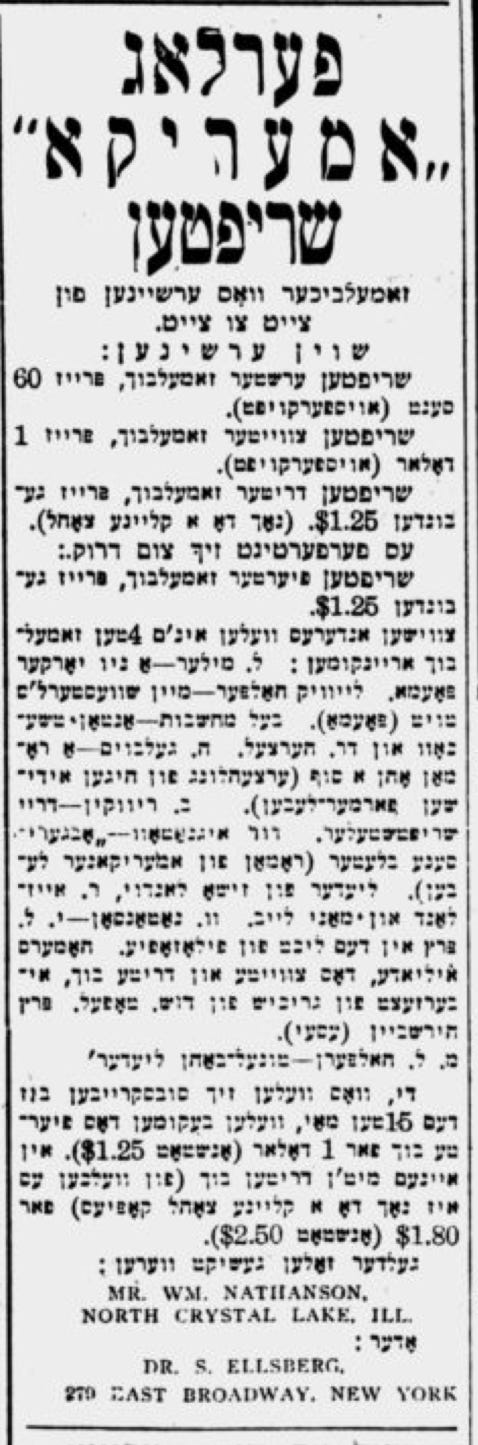
The ad from 1915 promising the poema ‘My Little Sister’s Death’ from Leivick Halper. The pseudonym really comes in 1917.
And I lied about the footnotes. Sorry.4
I’ll note again that a long poem (a poema) about his sister by the title of ‘My Little Sister’s Death’ was advertised as being included in a forthcoming edition, issue number 4, of Shriften back in 1915 (see the image above for the ad). It was not. I don’t know what happened to that poem(a). I wish I did. Perhaps it was recycled in part into this one? The longest gap I really know for certain is the gap between ‘Bullfight’ appearing in the newspaper and being collected — from 1943 to 1955. But I think the fact we have that advertised in 1915 puts a small seed of doubt into Sandor Goodheart’s theory that his sister’s death is something entirely repressed that Leivick can’t talk about. But ultimately, it didn’t happen, so perhaps there’s something to it after all…
This is also something which pushes in other directions, toward Heine’s mattress-tomb, as a sort of living death, and Beckett’s women giving birth astride graves — the circuit of life, a circle, with which Leivick would be particularly concerned latterly, completed nearly instantaneously. Leivick’s own cradles in graves show up in his war-time and post-war poetry, as well.
Unlike in Heaney’s poem, there’s an absence of the other siblings in Leivick’s, and there was at least one other (another sister, I think?) if not even more children at home at the time. This is fairly common with Leivick — we often get a laser focus on him and his parents, with minimal mention of the other siblings. If we follow the story of his sister in the 1954 interview with Y. Pat, we find that Leivick was on his way home from school and upon arrival was immediately taken to the neighbours the night of the accident, away from the house full of people. But all these granular details, again, are stripped away in Leivick’s poem.
Don’t worry, I remain cognisant that even the Klezmatics have day jobs and I shouldn’t give up mine. And I definitely don’t have chicken feet, you don’t need to check. I am something scarier than a shtetl sheyd.