
The Second Coming
He returns

‘Hey Bluma,’ you do not, in fact, say, ‘if there’s a Golem, where the hell is he during the whole Second World War? Isn’t that, like, the ideal time for him to have gotten up and done something? Did he just sleep through the whole thing?’
We actually do find out what Leivick’s Golem gets up to in this period — between swapping places with Hanina, the seeming Moshiach Ben David, in 1932’s Redemption Comedy (or The Golem Dreams, as it’s also sometimes called) to his hanging in Prague as part of the Slánsky trial in 1952 — through Leivick’s poetry.
The Golem shows up twice in In Treblinke bin ikh nit geven (I Was Not in Treblinka, 1945) which is comprised of poems from 1940-1945. One of these poems indeed finds him sound asleep in his attic.
Amongst Old Pages


Amongst old shemot sleeps the Song of Songs,
And in the attic sleeps the golem-man of clay,
And suddenly, a voice goes through all of him:
‘Oh, my longing for your home lies executed!’

What kind of a home? What kind of longing?
When was the execution and how?
Between attic walls, narrow and lonely,
The echo of his cry of pain remains trembling.

His deep sleep disturbed in haste,
He sits up — head on both knees:
And unexpectedly, beloved words
Greet him: It’s her, Dvorel.

It is that bright and modest Dvorel,
The last in the line of the Maharal of Prague;
The same Dvorel who had decided his fate
To remain clay and no longer see the light of day.

He raises his hands — they become lighter and lighter,
He stands, straights up and hits the roof,
And before he has time to touch anything with his fingers —
His body falls back down with a crash.

His eyes become blind, shut again,
His lips, though, are no longer closed —
A miracle: a quiet smile softly spread
To be a light in the attic night.

Amongst old pages of Tanakhs and siddurs
In the night of an attic sleeps the golem-man of clay,
But the Song of Songs no longer sleeps —
It guards a smile that remembers Dvorel’s home.
Both the Golem plays are conflated a bit here; Dvorel is from both plays — in the first, she’s the Maharal’s daughter and the Golem’s obsession with her is part of the reason he gets put away in the attic, in the second, she’s the last of the Maharal’s line, the first Dvorel’s descendant, in the attic of whose house the Golem is found. It doesn’t really matter, though, because they’re essentially doubles — just as the Golem and the Moshiach/Hanina come to be in the second Golem play. Or even Litvakov’s two incarnations from the article about the Golem at the Slánský trial, the prosecutor and the enemy of the state.
But Leivick seems entirely unconcerned by all that, so we won’t trouble ourselves with it either; perhaps there’s always a Golem, a Dvorel, an Elijah and a Moshiach who will meet in various configurations — the same players, acting out the same scenes, for all eternity.
The Golem wakes up briefly at the sound of something terrible — but hears a familiar voice and happily goes back to sleep. No vengeance to be had today. No pouring out of wrath.
The second reference to him in the book is a fleeting, but a far more sinister one. I Was Not in Treblinka closes with a ‘sonnet ring,’1 and the Golem appears in the fourth sonnet of the sequence. He’s no longer asleep there, but rather up to nothing good:
And now — apotheosis of horror: In the cemetery of Prague,
The Golem drinks wine from the Maharal’s skull,
And Jesus blasphemes God at the last sputtering.
Now I realise I’ve never gone into great depth on Golem here. That’s entirely intentional. I don’t want to spend any more time talking about it than I have to.
Try to talk about The Poet Went Blind — would I say this is about Golem and the search for language?2 No, I’d say it’s about a poet who is definitely not Morris Rosenfeld, he’s Maxim Thornfeld. Who just happens to also be a rather aggrieved Yiddish poet. And I don’t necessarily think that a discussion of autobiographical works needs to drag the Golem in either — it’s the messianism in Golem that’s important,3 not the Golem himself.
It’s the one play of Leivick’s for which I haven’t worked up a rough English draft because…who needs it? What would it add? If all we do is retranslate the same things, over and over, what progress do we actually make? Plenty of other people have covered Golem more than comprehensively and I don’t think it’s even a particularly good lens to view all of Leivick’s work through, though it is certainly the most popular.
One of the more interesting scenes of the dramatic poem, however, sees the Golem actually encountering the figure of ‘the Man with the Cross’ — that is to say, Jesus. And he rejects him outright for ‘smelling of death,’ which is Leivick’s own Jewish messianism and ideas about Jesus speaking there. I’ve previously shared quite a bit of his writing on the subject of Jesus and what he thinks of him and/or his followers, and we’ll be returning one of those poems in just a moment.
The proximity of Jesus and the Golem here is no accident. Nor is the Golem’s distain for the Maharal. The Golem doesn’t want control, he more often than not wants a bacchanalia— singing, dancing, drinking, lusting. And these are things that Leivick, more often than not, attributes to non-Jews, especially to Nazis.
We have to roll time back a little further still, to another period of intense anti-Jewish violence, and stop at roughly the juncture when Golem was written; Golem and — Leivick’s four long ‘pogrom poems.’
One of those four poems is, of course ‘Er’ (‘He’). I’ve looked at ‘He’ before, with its profane, incestuous desire and murder disguised as religion (or is it religion cloaked in lust for flesh and blood? Again, it doesn’t matter. It happens in all versions, all together, constantly, at once)
But now we’re going to turn off that road and continue into a poem that appears in Tog but doesn’t get collected into any books. A bit like the excerpts of the unfinished drama Lamed Vov, it’s possible it was abandoned before being completed. But what a fascinating little glimpse it is. In the same way that Jesus turned up at his doorstep over twenty years earlier, looking for all the world like a deranged pogromist who had just killed his own, Jewish, mother with a hammer…Jesus returns to demand worshipped. With the Golem in tow as his enforcer.
The Golem is certainly looking very civilised, with top-hat, tails and walking stick…
I must stress that Leivick calls it ‘His second visit,’ it’s the jokester in me that wants to make it a ‘second coming.’
He (from ‘His Second Visit’)


He comes in, an unexpected guest
Crowned with his old crown of thorns,
In company of a six-foot manservant,
He positions himself opposite with stiff step and says:

—Kneel before me, I am your God.

I look at him and the stoniness in his gaze.
And I say: The same, the same
As years ago, the same.

He starts and says:
— The same and not the same.
I used to come alone,
And now another accompanies me —
Do you see? Do you recognise my companion?

I look at his companion and cry out:
— Look, it’s Yosele Golem!
My old acquaintance, Yosele from Prague,
Look — in a top hat and tail coat,
With a gopher-wood stick in hand
Instead of his old-fashioned axe!

When I recover a bit I say:
— Sit…why don’t you sit.
Yosele Golem bursts into laughter,
And he, in the crown of thorns,
Says with a strange embarrassment:
—I can’t sit, I’ve come to stand before you,
As a God stands outstretched,
I’ve come to ask you:
Kneel before me,
Because I want to be your God. I do.

And before I have time to answer,
He continues:
— I’m tired of their kneeling,
I want new knees
That haven’t bent to me before now;
I want fresh hallelujahs from lips
That haven’t touched me before.
Recognise me as your God, I beg you.
I am sad — but I must become merry,
I am unfortunate — but I must become fortunate,
I am a failure — but I must succeed.
Recognise me as your God, I beg you.

I reply and say:
— Strange. Why do you need that?

He considers a while and says:
— I don’t need it so much as he does,
My companion, my Yosele.

I raise my eyes in fear and I ask:
— Your Yosele? Yours?
He belonged to the Maharal of Prague,
Then — to the Moshiach Ben David.
How does he suddenly come to be yours?

Yosele answers and says:
— I was the Maharal of Prague’s,
Then — the Moshiach Ben David’s,
But now I’m not the Maharal’s,
Or the Moshiach Ben David’s.
The Moshiach Ben David doesn’t want to come,
The Moshiach Ben David may not come,
The Moshiach Ben David can’t come,
The Moshiach Ben David is no more,
A great celebration — no more,
Hallelu, hallelu — no more.

I foresee a great misfortune in his words,
I foresee a great betrayal in his words,
I foresee it in his words and I ask: What happened?
What happened to the Moshiach Ben David?

Both answer in a strange voice,
In a strange voice, like before,
In a strange voice, with the same words:
        —The Moshiach Ben David doesn’t want to come,
The Moshiach Ben David may not come,
The Moshiach Ben David can’t come,
The Moshiach Ben David is no more,
A great celebration — no more,
Hallelu, hallelu — no more.
Unfortunately, I don’t have access to any more of the poem if, in fact, a rest exists. I don’t know if other excerpts were published elsewhere, and this appears to be the only segment that appeared in Tog.
A tantalising mystery.4
Leivick also gives us, across his many works, a few instances of a statue of Jesus coming to life, stepping down from the cross, and becoming an ordinary Jew again — when he does so in the war years, blasted down by artillery, he instantly becomes a Nazi-hunted Jewish refugee.
But if shop mannequins and public statues are the ‘Golem’s grandchildren,’ as per Leivick’s ‘New Yorkish,’ is he also a golem?
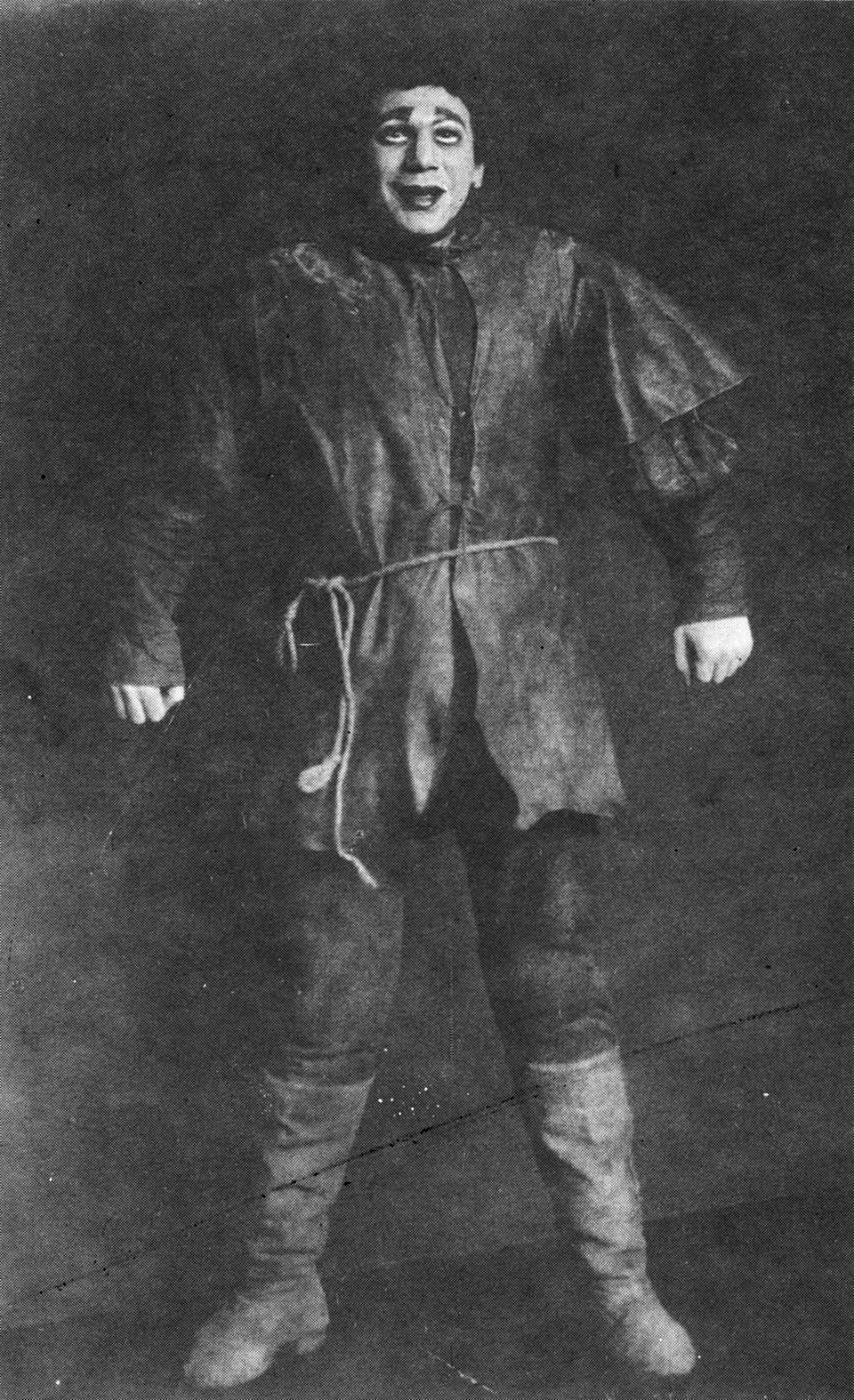
Aharon Meskin as Leivick’s Golem for Habima, borrowed from Wikipedia. Once again, Wegener’s Golem films (3 films, 1915-1920) are not based on Leivick’s Golem, as I sometimes see passed around. Whether or not Leivick saw these films himself, I can’t say.
More commonly in English a ‘crown of sonnets,’ and in this case, the fifteen sonnets are a ‘heroic crown’ as there are fifteen, with the last of them comprised of the first lines of all the preceding fourteen sonnets — the ‘Mastersonnet.’
This, incidentally, is a slightly weird question to ask about Leivick’s Golem. Yosele won’t stop talking. With all the languages that Leivick’s Golem has been translated into — it was first performed in Hebrew — finding a language isn’t his problem at all. He’s talking before he’s even ‘born.’
If you read one bit of criticism about the Golem, it’s my opinion you should make it Levi Shalit’s book on the figure of the Messiah in Leivick’s plays where he makes a trilogy out of the two Golem plays and Chains of the Moshiach. The fourth Moshiach play — Wedding in Foehrenwald — hadn’t been written yet.
The missing pieces of another Golem-adjacent work, ‘New Yorkish,’ also remain a mystery to me. Was there ever a conclusion? Is there a more completely and legible copy out there? I have tried asking around, but surely I must mean Lamed Shapiro’s story by the same name….alas, I do not.